guides
How to Smoke Prime Rib: Step-by-Step Guide
Learn to smoke prime rib perfectly: dry brine, seasoning, temperatures, wood choice, and how to finish with a sear for a restaurant-quality holiday roast.
 Cole Whitaker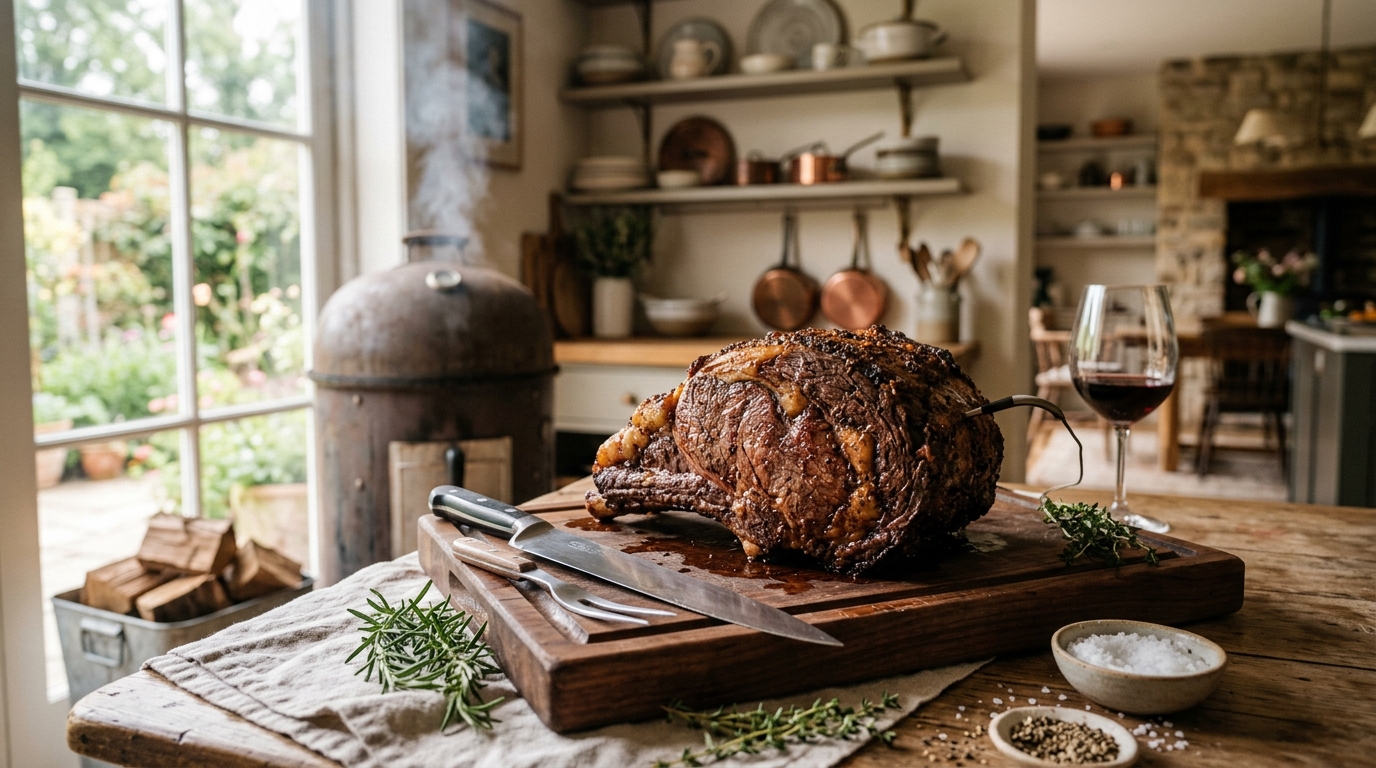
The most reliable method for smoking prime rib: dry brine the roast uncovered in the refrigerator for 24–48 hours, smoke at 225–250°F until the center reaches 120–125°F for medium-rare, then sear at 500°F+ for 10–15 minutes to build the crust. Total active cook time runs 15–20 minutes per pound at 225°F, with a 30-minute rest before carving.
Bone-in vs. boneless prime rib: which should you smoke?
The choice between bone-in (standing rib roast) and boneless prime rib affects cook time, flavor, and ease of carving. Both produce excellent results on the smoker, but the trade-offs are real.
| Product | Best for | Rating | Notes | |
|---|---|---|---|---|
| Bone-in standing rib roast | Maximum flavor, dramatic presentation, holiday centerpiece | ★★★★★ | Bones act as a natural roasting rack, promote airflow underneath, and contribute gelatin to the meat during the cook. The meat nearest the bones is the most flavorful and tender portion. Cook time is slightly longer. Carving requires one extra step to remove the bones, but most cooks cut them away in a single pass along the rib cage before slicing. Best for holiday cooking where presentation matters. | Check price |
| Boneless prime rib (ribeye roast) | Easier carving and slightly faster cook time | ★★★★☆ | Cooks slightly faster and more evenly edge-to-edge since there is no bone mass to slow heat transfer at the center. Easier to slice into even portions at the table. Slightly less flavorful near the center than a bone-in roast of the same grade. Needs to be tied with butcher twine to hold its shape on the smoker. Good choice when cook time precision matters more than maximum flavor. | Check price |
For most situations, bone-in is the better choice on a smoker. The longer cook time gives the bones more time to contribute flavor, the roast holds its shape without tying, and the visual impact at the table is hard to match. If you are cooking for a crowd that values convenience over flavor complexity, or if your smoker has limited height clearance, boneless is a valid option.
What you need before you start
Non-negotiable equipment:
- A smoker capable of holding 225–250°F steadily for 3–7 hours depending on roast size
- A dual-probe wireless thermometer — one probe monitoring the roast interior, one at grate level for accurate cook temperature
- A sharp carving knife and a sturdy cutting board with a juice channel
- Butcher twine if cooking a boneless roast (to bind it into a tight cylinder for even cooking)
Strongly recommended:
- A cast iron skillet or dedicated sear station for the high-heat finish
- A rimmed sheet pan for the dry-brine stage
- Heavy-duty heat-resistant gloves for handling the hot roast
A reliable wireless dual-probe thermometer for monitoring prime rib: wireless dual probe meat thermometer on Amazon
Cotton butcher twine for tying a boneless roast: butcher twine cooking cotton on Amazon
How to dry brine prime rib
Dry brining is the single highest-impact step you can take before the roast hits the smoker. Applied 24–48 hours ahead of time, kosher salt draws moisture out of the muscle fibers through osmosis, dissolves in that surface moisture, and then gets reabsorbed back into the meat — seasoning it deeply from the surface inward. Simultaneously, the extended uncovered refrigerator rest dries the exterior completely, which is what allows the Maillard reaction to happen rapidly during the finishing sear.
How to dry brine:
- Pat the roast completely dry with paper towels before applying the brine
- Apply 0.5 teaspoon of kosher salt per pound of meat across every surface — top, bottom, sides, and between bones if bone-in
- Add any herbs and spices at this stage: coarsely cracked black pepper, garlic powder, dried rosemary, dried thyme, and smoked paprika all work well
- Place the roast fat-cap up on a wire rack set inside a rimmed sheet pan
- Refrigerate uncovered for 24–48 hours — the longer the better for crust development
- Remove from the refrigerator 45–60 minutes before cooking to take the chill off the exterior
Do not rinse the salt off before cooking. There is no excess salt to wash away — it has fully absorbed into the meat.
Step-by-step: how to smoke prime rib
Step 1: Set up your smoker at 225–250°F
Pre-heat your smoker to a stable 225–250°F before the roast goes on. Use the temperature probe at grate level — not the dome gauge, which often reads 15–25°F higher than actual cooking temperature near the meat.
Add your chosen wood at startup. Unlike brisket, prime rib does not need hours of continuous heavy smoke. Two to three fist-sized wood chunks for a kettle or offset smoker, or a partially filled hopper of wood pellets on a pellet grill, is sufficient. The goal is clean thin blue smoke, not billowing white smoke — the latter makes the exterior acrid and deposits bitter compounds rather than sweet smoke flavor.
Step 2: Season the roast and insert the probe
Remove the dry-brined roast from the refrigerator. At this stage, no additional salt is needed — the dry brine has done the work. Apply a light coating of beef tallow, softened butter, or a small amount of avocado oil to the entire exterior surface to help any final seasoning adhere and to promote browning during the sear. Apply a fresh crack of black pepper if desired.
Insert the thermometer probe into the geometric center of the roast, angled to avoid the bones (bone conducts heat and reads falsely high) and the fat cap (fat heats differently than muscle). The probe tip should be in the thickest section of the longissimus dorsi muscle — the main eye of the roast.
Step 3: Smoke to 120–125°F internal temperature
Place the roast fat-cap up directly on the smoker grate. Fat-cap up allows the rendered fat to baste the meat naturally as it drips down the exterior during the cook.
Target pull temperatures by desired doneness:
| Doneness | Pull Temperature | Final After Rest |
|---|---|---|
| Rare | 110–115°F | 118–123°F |
| Medium-rare (recommended) | 120–125°F | 128–133°F |
| Medium | 130–135°F | 138–143°F |
| Medium-well | 140–145°F | 148–153°F |
Approximate cook times at 225–250°F:
| Roast Weight | Estimated Time |
|---|---|
| 4–5 lb (2-bone) | 2–3 hours |
| 6–8 lb (3-bone) | 3–4.5 hours |
| 10–12 lb (4-5 bone) | 4.5–6 hours |
| 14–16 lb (6-7 bone) | 6–8 hours |
These are estimates. Always cook to temperature, not time. A roast that stalls in temperature or a cooler-than-expected smoker can push well past these ranges. Set the high-alarm on your wireless thermometer 5°F before your target pull temperature so you have time to transition to the sear.
Step 4: Rest the roast before searing
When the probe hits your target pull temperature, remove the roast from the smoker and tent loosely with foil. Rest for 20–30 minutes. During this time the internal temperature continues climbing 5–8°F through carryover cooking, and the juices redistribute through the muscle fibers. Do not skip or shorten this rest — meat carved immediately loses a significant pool of juice on the cutting board, not in the portion on the plate.
Step 5: Finish with a high-heat sear
After resting, the roast needs a quick high-heat sear to form the brown, crispy, flavorful crust. The dry brine dried the exterior specifically to make this step work efficiently.
Option 1 — Smoker sear: Crank the smoker to its maximum temperature (usually 500–600°F on a pellet grill) and return the roast for 10–15 minutes, rotating once. Works well on pellet grills with a sear mode.
Option 2 — Oven broiler: Transfer the roast to a rack in a roasting pan and slide it under a preheated broiler set to high. Broil 6–8 inches from the element for 8–12 minutes, watching closely, until the exterior is deep brown.
Option 3 — Cast iron sear: Heat a large cast iron skillet over highest heat until smoking, add a tablespoon of tallow or avocado oil, and sear each surface of the roast for 1–2 minutes per side. Excellent crust but requires a skillet large enough to handle the roast and good ventilation.
Step 6: Carve and serve
Carve bone-in roasts by setting the roast cut-side down and slicing between the bones first to remove the entire rack in one piece, then slicing the eye muscle into portions. Alternatively, stand the roast on the cut end and slice along the bones one at a time, separating each bone with its attached meat.
For boneless roasts, simply slice perpendicular to the length into 3/4-inch to 1-inch portions.
Choosing the best wood for smoked prime rib
Prime rib is a beef roast with significant fat marbling and a long cook time — it takes smoke very well and can handle moderate smoke intensity. The wrong wood in large quantities (mesquite, heavy hickory) can push the exterior toward acrid bitterness over a 4–6 hour cook.
Oak is the best all-around wood for prime rib. It produces moderate smoke with a clean, slightly earthy character that pairs naturally with beef without adding sweetness or fruitiness. Post oak is the classic choice of Texas-style barbecue for a reason — it complements beef better than nearly any other wood.
Cherry is an excellent complement to oak. Used at a 1:1 or 1:2 ratio with oak, cherry adds mild sweetness and dramatically enhances the color of the bark — prime rib smoked with cherry gets a deep red-mahogany exterior that photographs beautifully.
Pecan is a good middle ground — more depth and complexity than fruit woods, less intensity than hickory. It works well as a standalone wood for prime rib and is widely available.
Hickory works in moderate quantities: use one chunk of hickory alongside two of oak or cherry rather than running hickory alone for a 5-hour cook. In large amounts over a long cook, hickory becomes bitter and can overpower the delicate beefy flavor you are trying to preserve.
Avoid mesquite for prime rib. Mesquite burns hot and produces intense, peppery smoke that works well for short cooks at high heat (brisket flat, short ribs) but becomes acrid and overpowering on a 4–6 hour low-and-slow roast.
A wood chunk variety for smoking beef: oak cherry hickory wood chunks for smoking beef on Amazon
Common mistakes when smoking prime rib
Pulling too late. Prime rib continues cooking during the rest (carryover), and overcooked prime rib cannot be fixed. Pull the roast 5–8°F below your target doneness and trust the carryover process. A probe thermometer is not optional for this cut.
Skipping the dry brine. A roast seasoned the morning of cooking has salt only on the surface — it has not migrated into the meat and the exterior has not dried enough for a proper sear. Without the 24–48 hour window, you get under-seasoned, moist-surface roast that steams rather than sears.
Not finishing with high heat. A roast smoked to 125°F and carved without a finishing sear has a gray, soft exterior with no contrasting crust. The Maillard reaction — the browning that creates the complex flavors people associate with great roasted beef — requires surface temperatures above 300°F. Low-and-slow smoking alone never achieves this.
Opening the smoker lid too often. Each lid opening drops cook temperature 25–50°F and extends the cook time. Insert your probe before the roast goes on and monitor remotely. The only reason to open the smoker is to add wood if the temperature drops or to pull the roast when it hits temperature.
Cooking from cold. A large bone-in roast pulled straight from the refrigerator has a 38–40°F center at the start. The outer 2 inches cook far ahead of the center, creating a large gray band of overcooked meat surrounding the desired pink interior. The 45–60 minute rest at room temperature before cooking dramatically narrows that gradient.
FAQ
Frequently asked questions
How long does it take to smoke prime rib?
What temperature should I smoke prime rib at?
What internal temperature should prime rib reach?
Do I need to sear prime rib after smoking?
What is the best wood for smoking prime rib?
Should I smoke prime rib bone-in or boneless?
How long should prime rib rest after smoking?
Bottom line
Smoked prime rib is one of the most rewarding things you can cook outdoors: a long, low-and-slow smoke produces edge-to-edge medium-rare doneness that an oven alone cannot replicate, with smoke-ring color and complex flavor that elevates a great cut of beef to something extraordinary. The process is not difficult, but it requires planning — dry brine 24–48 hours ahead, pull at 120–125°F for medium-rare, rest for 20–30 minutes, then finish hard and fast to lock in the crust. Follow those four steps and the result speaks for itself.
For related reading: the right internal temperature for prime rib by doneness level, how to smoke beef ribs low and slow, brisket smoking guide: times, temps, and technique, or best wood chunks for smoking beef and pork.