guides
How to Grill Pork Chops
Grill juicy pork chops every time: two-zone sear, 145 F pull temp, bone-in vs boneless timing tables, and the dry-brine trick that keeps lean chops moist.
 Cole Whitaker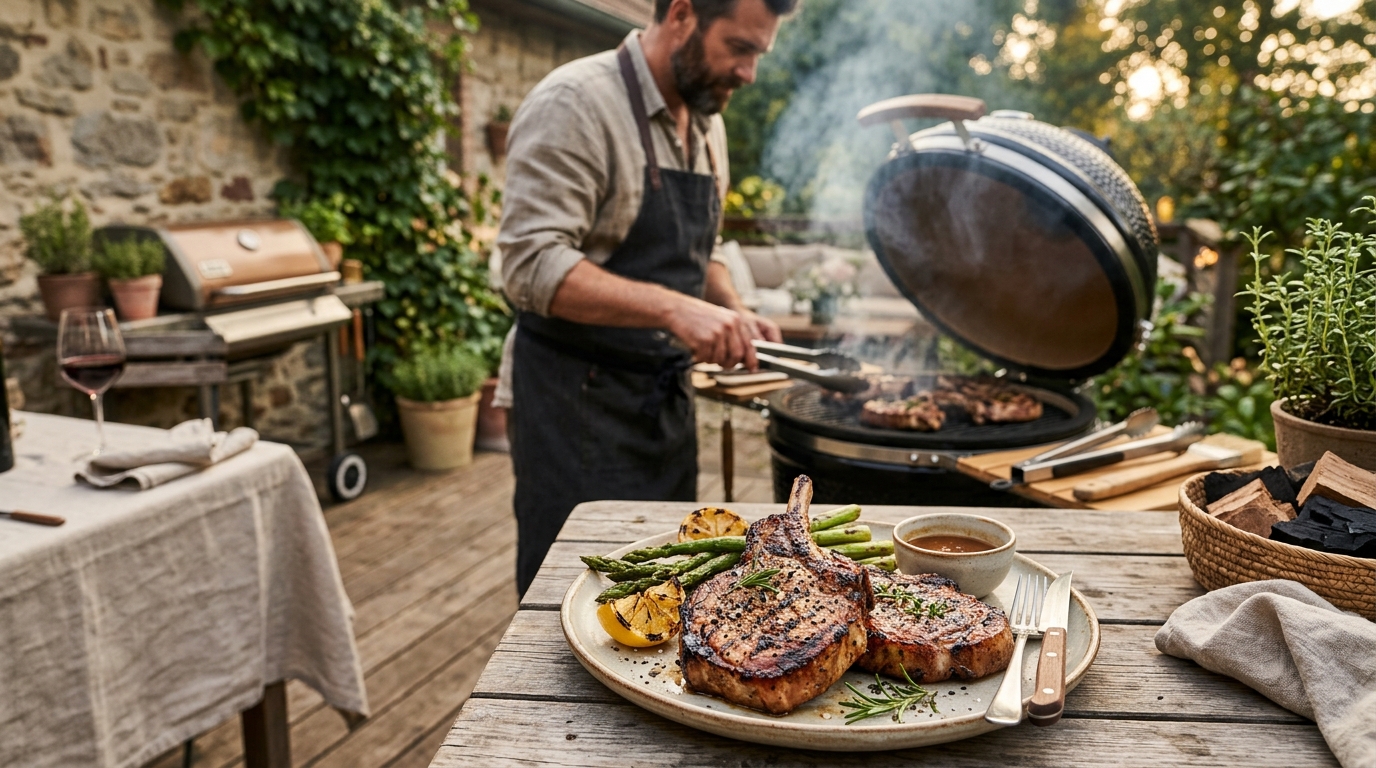
Grill bone-in pork chops using the two-zone method: sear over direct high heat for 2–3 minutes per side to build a crust, then finish over indirect heat until the internal temperature reads 145°F. Boneless chops under ¾ inch can cook entirely over direct heat in 4–6 minutes. Pull at 145°F and rest 3 minutes — that step is what keeps pork chops juicy instead of chalky.
What makes pork chops harder to grill than other cuts?
Pork chops are unforgiving because they are lean and thin. A 1-inch boneless pork loin chop has almost no intramuscular fat to buffer against overcooking — the difference between 145°F and 165°F is the difference between a juicy, slightly pink chop and a dry, rubbery one. Most overcooked pork chops come from two sources: outdated cooking advice (the old USDA guideline recommended 160°F for pork, revised down to 145°F in 2011) and the absence of a thermometer.
The bone changes the equation significantly. A bone-in rib chop takes longer to heat through because the dense bone slows heat transfer in the surrounding meat. That extra time is actually an advantage — the interior heats more gradually, leaving a wider window to hit 145°F before the exterior overcooks. If you are learning to grill pork chops, start with bone-in chops while you build confidence with the timing.
Which cut of pork chop should you buy?
Not all pork chops grill the same. The cut determines cook speed, flavor depth, and how likely it is to dry out.
Rib chops — Cut from the rib section of the loin, these are the most marbled chops on the animal. Visible fat runs in thin veins through the meat rather than only as a surface cap. They grill quickly and carry the deepest pork flavor. Look for at least a ¼-inch fat cap and trim to ⅛ inch before grilling to limit flare-ups. This is the best all-around choice for grilling.
Loin chops (center-cut or T-bone) — The T-bone pork chop has a section of loin and a section of tenderloin separated by a bone, similar to a T-bone beef steak. The loin side is lean; the tenderloin side is even leaner and cooks slightly faster. Managing both sides simultaneously is trickier than a straightforward rib chop, but the flavor is excellent. Pull at 145°F and neither side will be overdone.
Boneless loin chops — The most common cut in American supermarkets. All loin, no bone, very lean. Fast to cook and easy to portion, but they forgive almost no errors. A brine is not optional here — it is the primary defense against dryness. Buy them at least ¾ inch thick; anything thinner overcooks before you can react.
Sirloin chops — Cut from near the hip, these are chewier and cheaper. They benefit from a marinade and are better suited to braising than to quick grilling. Not the best choice for a fast grill session.
Shoulder (blade) chops — The most marbled cut and the most affordable. They have significant connective tissue that can make them slightly chewy when grilled quickly, but the fat keeps them moist even if you miss the temperature by several degrees. A good choice for beginners who want a forgiving cut.
How to prepare pork chops for the grill
Step 1: Choose the right thickness
One inch is the ideal thickness for grilling pork chops. It is thick enough for a two-zone setup — you get a proper sear on the outside before the inside overcooks — but not so thick that it requires a long indirect cook. Anything thinner than ¾ inch moves from raw to overcooked in under 5 minutes over direct heat, leaving almost no margin for error. If the store only carries thin chops, adapt: skip the two-zone, use direct medium heat, and check with a thermometer at the 4-minute mark.
Step 2: Dry brine for at least 45 minutes
A dry brine is the most effective prep step for keeping pork chops moist. Rub the chops evenly on all surfaces with kosher salt — ½ teaspoon per pound is the right ratio — and let them rest uncovered on a rack in the refrigerator for 4–24 hours. The salt draws a small amount of moisture to the surface initially, then the meat reabsorbs it along with the dissolved salt. This seasons the chop from the inside rather than just the surface, and the salt restructures the proteins slightly to help them hold onto moisture during cooking. A 45-minute countertop dry brine works if you are short on time; overnight is noticeably better on boneless chops.
If you want to add a dry rub, apply the additional seasonings on top of the salt when the chops come out of the refrigerator. Garlic powder, smoked paprika, onion powder, black pepper, and a small amount of brown sugar for caramelization all work well together.
Step 3: Let the chops come to room temperature
Pull the chops from the refrigerator 20–30 minutes before grilling. This reduces the temperature gap between the exterior and the interior, producing a more even cook. A refrigerator-cold chop has a colder center that lags behind the surface, which can result in an overdone exterior before the interior reaches 145°F. This step matters more for thicker chops (1.5 inches or more) and less for thin boneless chops.
Step 4: Pat dry and finish seasoning
Pat the surface completely dry with paper towels, even after a dry brine. Moisture on the surface creates steam on contact with the hot grates and delays browning. A dry surface is the prerequisite for a proper crust. Add any remaining dry rub seasonings at this point rather than before refrigerating, since some seasonings (like brown sugar) can pull additional moisture if left on overnight.
How to grill pork chops: step-by-step
Step 1: Set up two zones and preheat
For gas grills, heat all burners on high for 15 minutes, then reduce one side to medium-low to create an indirect zone. For charcoal, light a full chimney, let the coals ash over completely, then bank them two-thirds to one side. You need a direct zone at 400–450°F and an indirect zone at roughly 300–325°F. The two-zone setup lets you sear over direct heat to build a crust, then finish the interior over indirect heat without burning the outside.
Step 2: Clean and oil the grill grates
Brush the preheated grates with a wire grill brush, then wipe them with a paper towel folded into quarters and soaked in high-smoke-point oil — canola, vegetable, or avocado oil — held with long tongs. This removes residue and creates a non-stick surface that lets the chops release cleanly once a crust forms. The fat cap on bone-in chops provides its own basting, but cleaning the grates first remains essential.
Step 3: Sear over direct heat
Place the chops directly over the hot zone. Close the lid. Do not move them until a crust has formed — lifting too early tears the sear and leaves it stuck on the grates. After 2–3 minutes, check: if the chop releases cleanly from the grates, the crust has formed and it is ready to flip. If it sticks, give it another 30–60 seconds. Flip and sear the second side for 2–3 minutes. For bone-in chops, hold each chop on its side briefly with long tongs to sear the fat cap until it is golden and rendered.
Step 4: Move to indirect heat and finish to 145°F
After searing, slide the chops to the indirect zone. Close the lid and check the internal temperature with an instant-read thermometer every 2–3 minutes, inserting the probe into the thickest part of the chop without touching bone. Indirect finish time depends heavily on thickness:
| Chop Thickness | Sear Time | Indirect Finish | Total Time |
|---|---|---|---|
| ½ inch boneless | 2 min per side, direct only | None | 4–5 min |
| ¾ inch boneless | 2 min per side | 2–4 min | 6–9 min |
| 1 inch bone-in or boneless | 2–3 min per side | 4–7 min | 9–13 min |
| 1.5 inch bone-in | 3 min per side | 8–12 min | 14–18 min |
These times assume a grill preheated to 400–450°F over direct heat with an indirect zone at 300–325°F. Wind, ambient temperature, and whether the chop started refrigerator-cold all affect actual cooking time. Use the table as a starting point and the thermometer as the final authority.
Step 5: Pull at 145°F and rest for 3–5 minutes
Remove the chops from the grill the moment the thickest point reads 145°F. The internal temperature will continue to rise 3–5°F during the rest. Transfer to a cutting board or warm plate and tent loosely with foil. Rest for at least 3 minutes — 5 minutes is better for thick bone-in chops. Cutting immediately after pulling causes the contracted muscle fibers to push their juices onto the board instead of keeping them in the meat. The rest lets them relax and reabsorb the liquid.
Pork chop internal temperature guide
| Internal Temp | Doneness | Notes |
|---|---|---|
| 145°F | Safe and juicy | USDA safe minimum; slightly pink center is correct |
| 150°F | Medium | Less pink, still tender |
| 155°F | Medium-well | Minimal pink, starting to dry out |
| 160°F+ | Overdone | Dry, chalky — the most common mistake |
The 2011 USDA revision that lowered the safe pork temperature from 160°F to 145°F matters enormously for pork chops. The difference in texture and moisture between 145°F and 160°F on a lean boneless chop is dramatic. If you have been cooking pork chops to 160°F because that was the old standard, switching to 145°F will produce a noticeably better result from the first cook.
Tools that make grilling pork chops easier
A reliable instant-read thermometer is the one tool that changes the outcome on pork chops more than any other single purchase. The ThermoWorks Thermapen One reads in 1 second with ±0.5°F accuracy. The ThermoPop 2 reads in 3 seconds for significantly less money and performs nearly as well for home cooks. Either one will tell you exactly where you are relative to the 145°F target. Guessing by look, touch, or time is not reliable on a lean cut with this narrow a temperature window.
Long-handled grill tongs with a locking mechanism give you control when flipping chops and holding them on edge to sear the fat cap. Avoid using a fork or spatula with a piercing tip to handle the chops — puncturing the meat during cooking lets juices escape.
A wireless leave-in probe thermometer is useful for thick bone-in chops where the indirect finish phase can run 10 or more minutes. It monitors temperature continuously without requiring you to repeatedly open the lid and drop grill temperature.
Common mistakes when grilling pork chops
Cooking to 160°F. This is by far the most common mistake and the leading cause of dry pork chops. At 160°F, lean boneless chops are overcooked by 15 degrees and noticeably dry in texture. The USDA revised the safe pork temperature to 145°F in 2011. A slightly pink center is correct and safe at that temperature.
Skipping the dry brine. Dry brining is especially important for lean boneless chops. Without it, the chops shed a higher percentage of their moisture during cooking. A 45-minute brine at room temperature is a minimum; overnight in the refrigerator produces a noticeably better result and requires almost no active time.
Buying chops that are too thin. A ½-inch boneless chop goes from raw to overcooked in under 4 minutes over direct heat. There is almost no margin for error at that thickness. When buying chops specifically to grill, ask the butcher to cut them at least 1 inch thick, or buy bone-in cuts. Thicker chops are far easier to manage.
Moving the chops too early. Pork chops stick to grill grates initially and release cleanly once a crust has fully formed. Attempting to flip before the crust is ready tears the sear off and leaves it on the grates, leaving the chop with a pale, steamed exterior on that side. The chop will signal readiness — it lifts cleanly rather than pulling and tearing.
Pressing down on the chops. Pressing with a spatula forces out the juices that would otherwise remain inside the meat. It does not speed cooking in any meaningful way. Leave the chops alone between flips.
Cutting immediately after pulling from the grill. Even a 3-minute rest changes the texture significantly. Muscle fibers contract during cooking and relax during rest. Cutting immediately causes the juices to pour onto the board rather than staying in the meat. That pooled liquid on the board is moisture that should have been in the chop.
FAQ
Frequently asked questions
What temperature should pork chops be grilled to?
How long does it take to grill pork chops?
Should you grill pork chops on high heat?
Should you marinate pork chops before grilling?
Can you grill frozen pork chops?
Why do grilled pork chops turn out dry?
Do you grill pork chops with the lid open or closed?
Bottom line
Pork chops are one of the most affordable proteins on the grill, and they are reliably excellent when you follow three fundamentals: choose chops at least 1 inch thick, dry brine with kosher salt for at least 45 minutes, and pull at 145°F rather than the outdated 160°F guideline. The two-zone method — sear directly, finish indirect — gives you the crust and the controlled interior temperature you need to hit that target consistently. A fast-read thermometer is the one tool that makes the difference between a juicy chop and a dry one on every cook.
For related reading: how to grill pork tenderloin, direct vs. indirect grilling explained, best instant-read thermometers for the grill, and the best meat thermometer for pork chops.