guides
How to Smoke Mac and Cheese: The Complete Guide
Learn how to smoke mac and cheese on any backyard smoker — perfect cheese sauce, wood selection, timing, and the best toppings for smoky depth.
 Cole Whitaker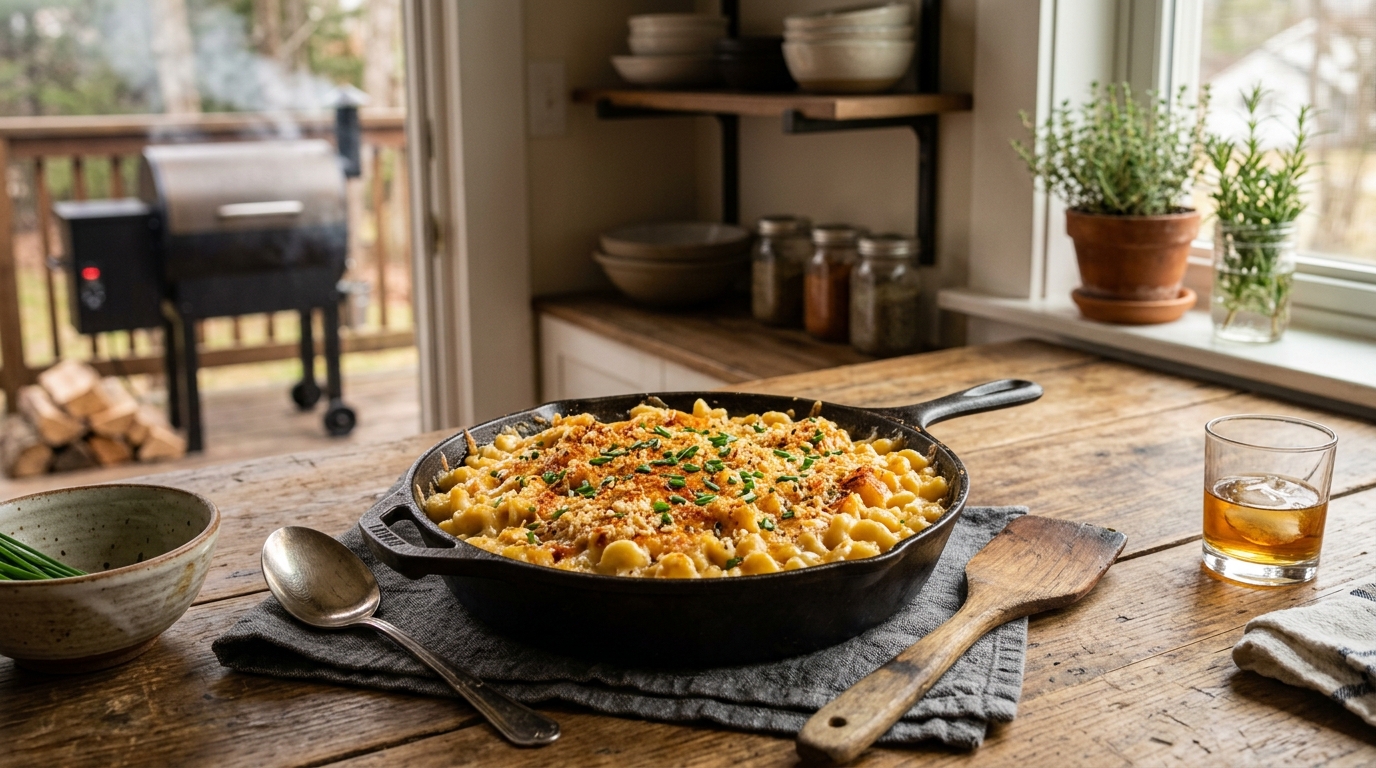
The fastest path to smoked mac and cheese: build a roux-based cheese sauce, fold in cooked pasta, transfer to a cast-iron skillet, and smoke at 225°F for 45 to 60 minutes over apple or cherry wood. The smoke perfumes the sauce without overwhelming the dairy — 20 minutes of active cooking, then the smoker handles the rest.
Why smoked mac and cheese works so well
Mac and cheese is mostly fat and dairy — a near-perfect canvas for smoke. Butter, heavy cream, and melted cheese absorb smoke flavor readily because smoke compounds are fat-soluble. The same chemistry that makes bacon smell incredible next to a campfire applies here at a lower, gentler temperature.
The difference between smoked mac and cheese that tastes like a revelation and one that tastes like an ashtray is restraint: mild wood, a moderate temperature, and less time on the smoker than you probably think you need. You are not trying to drive a smoke ring into pasta. You are laying a background note of woodsmoke that lingers behind the richness of the cheese without competing with it.
A well-made smoked mac and cheese — set surface, creamy interior, golden breadcrumb top — holds up as a main dish, not just a side. It is also one of the most forgiving things you can make on a smoker. There is no stall to push through, no connective tissue to break down, and no resting time required. If you can build a cheese sauce, you can make this.
Equipment checklist
You do not need specialized gear, but a few items make the process easier and avoid the most common failure modes.
The essentials:
- A smoker or grill set up for indirect heat
- A 12-inch cast-iron skillet or a heavy-gauge disposable aluminum pan (a 9x13 inch disposable works well for larger batches)
- A heavy-bottomed pot or Dutch oven for building the sauce
- A whisk for the roux
- A wood thermometer to confirm smoker temperature — the built-in gauge on most smokers is unreliable
Avoid ceramic baking dishes directly on the smoker grate. The sharp temperature differential between the hot grate and the cooler ceramic base can cause thermal cracking, especially on offset smokers where grate temperatures can spike near the firebox. A cast-iron skillet eliminates this risk entirely and retains heat efficiently for serving.
A 12-inch cast-iron skillet for the smoker: Lodge 12-inch cast iron skillet on Amazon
For the cheese blend, smoked gouda is the single most impactful upgrade you can make. Pre-smoked gouda adds a layer of smokiness before the pan ever touches the grate, effectively doubling the smoke character you get at the end. Pair it with sharp cheddar for bite and a small amount of cream cheese for stability at heat.
Smoked gouda block for shredding: smoked gouda cheese on Amazon
Build the cheese sauce first
The cheese sauce is the foundation of the dish, and shortcuts here produce mediocre results. A proper roux — butter and flour cooked together — creates a stable emulsion that holds together at smoker temperatures without breaking into a greasy pool. Skipping the roux and melting cheese directly into cream is the most common reason smoked mac and cheese disappoints.
Ingredients for 6–8 servings as a side dish:
- 1 pound elbow macaroni or cavatappi
- 4 tablespoons unsalted butter
- 4 tablespoons all-purpose flour
- 2 cups whole milk, warmed
- 1 cup heavy cream
- 8 oz smoked gouda, shredded (not pre-shredded — the anti-caking coating prevents smooth melting)
- 8 oz sharp cheddar, shredded
- 4 oz cream cheese, cubed
- 1 teaspoon dry mustard powder
- 1 teaspoon garlic powder
- 0.5 teaspoon smoked paprika
- Salt and black pepper to taste
Building the sauce:
Cook pasta to just shy of al dente — about 2 minutes less than the package directions. It will finish cooking on the smoker and absorb residual sauce as it does. Drain and set aside.
In a heavy-bottomed pot over medium heat, melt the butter. Add flour and whisk constantly for 2 minutes until the roux smells faintly nutty and turns a light golden color. This step cooks out the raw flour taste.
Add warmed milk in a slow, steady stream, whisking constantly to prevent lumps from forming. Add the heavy cream. Bring to a gentle simmer, stirring frequently, until the sauce thickens enough to coat the back of a spoon — about 5 to 7 minutes.
Remove from heat. Add the cream cheese first and stir until fully melted. Add the dry mustard, garlic powder, and smoked paprika. Add the shredded gouda and cheddar in batches, stirring each addition until completely melted before adding the next. Off-heat cheese addition is the key step — adding cheese to a sauce that is still at a full boil causes it to seize and turn grainy.
Season with salt and pepper. The sauce should taste slightly over-seasoned at this point — the smoker will mellow it. Fold in the drained pasta until every piece is evenly coated.
How to smoke mac and cheese: step by step
Step 1: Preheat your smoker to 225°F. Stabilize the temperature before the pan goes on. Temperature swings during the first 15 minutes cause uneven cooking and can cause the sauce to break on contact with a spiked heat source. On an offset smoker, build your fire as normal and add one small split of apple or cherry wood once you hit temperature. On a pellet smoker, set to 225°F and let it fully preheat.
Step 2: Transfer the mac and cheese to the skillet or pan. Pour the pasta and sauce into your cast-iron skillet or aluminum pan. Spread evenly so the surface is flat — smoke absorption happens at the surface, and an even layer gets uniform coverage. If using a disposable pan, set it on a half-sheet baking pan for structural support and easier transport.
Step 3: Place the pan on the smoker over indirect heat. Position the pan away from the hottest zone. On an offset smoker, that means toward the chimney end and away from the firebox. On a kettle grill set up two-zone, that means the cool side with the lid vent positioned over the pan to draw smoke across it. On a pellet grill, center of the grate is fine — heat is distributed evenly.
Step 4: Smoke uncovered for 30 minutes, then assess. After 30 minutes, check the surface. You should see a light skin beginning to form on top and the edges starting to set slightly. The sauce inside should still look loose and creamy. This is exactly where you want it at the 30-minute mark.
If the top is browning faster than expected, the pan is too close to a hot zone — rotate it 180 degrees and continue. If the surface looks identical to when you put it on, your temperature may be running lower than the dial indicates. Confirm with a grate-level probe thermometer and adjust accordingly.
Step 5: Add the breadcrumb topping at the 45-minute mark. Combine 1 cup of panko breadcrumbs with 2 tablespoons of melted butter and a pinch of salt. Stir until the crumbs are evenly coated. Spread the mixture across the top of the mac and cheese in an even layer.
Return to the smoker for 15 minutes. The goal is golden-brown, toasted crumbs. Watch this phase more actively than the smoke period — panko goes from perfectly golden to burnt in about 3 minutes at the wrong temperature or over a hot zone.
Step 6: Pull at 60 minutes total, or when edges are fully set. The mac and cheese is done when the edges are clearly set and pulling very slightly away from the pan sides, the center has only a slight jiggle when the pan is moved, and the breadcrumb topping is evenly golden. Internal temperature of the sauce is not a reliable indicator here — focus on visual and textural cues rather than a number on a thermometer.
Step 7: Rest 5 minutes before serving. The sauce will look thin immediately off the smoker. A 5-minute rest lets the starch in the pasta finish absorbing and the sauce firm to a scoopable consistency. Serve directly from the cast-iron for both visual impact and retained heat.
Which wood works best for smoked mac and cheese
Wood selection matters more for mac and cheese than for most smoked proteins because dairy absorbs smoke character readily. With a brisket, 12 hours of cook time softens and integrates even aggressive smoke. With mac and cheese, you have 45 to 60 minutes of total exposure — overdo the intensity and you taste nothing but smoke.
Apple wood is the recommended default. Apple burns clean, produces mild and slightly sweet smoke, and pairs naturally with dairy without competing. It is forgiving — even a slightly heavier dose does not ruin the dish. First-timers should start here.
Cherry wood adds a subtle fruitiness and produces a beautiful light golden-brown color on the surface of the mac and cheese. The flavor is slightly more pronounced than apple but still gentle enough for dairy. It works particularly well with a cheese blend that includes gruyere or fontina.
Pecan is the most complex of the mild woods. Its nutty, subtle smoke adds dimension without aggression and works well when the cheese blend includes sharp aged varieties. A good choice for cooks who want something a step up from apple or cherry.
Hickory is a borderline option. One small chunk (or pellets mixed 50/50 with apple) adds a recognizable BBQ smokiness that pairs well with bacon-included variations. At full dose, hickory overwhelms the dairy entirely. If you use hickory, add half the amount you think you need.
Mesquite: avoid entirely. Mesquite is too aggressive for a short cook with fat-rich dairy. The result tastes medicinal and sharp rather than smoky and rich. Save it for brisket and beef-forward cooks where the long cook time tames its intensity.
Apple wood chunks for charcoal or offset setups: apple wood chunks on Amazon
Apple wood pellets for pellet smokers: apple wood pellets on Amazon
Variations worth making
Smoked bacon mac and cheese: Cook 6 strips of thick-cut bacon until crispy, crumble, and fold into the cheese sauce before it goes on the smoker. The bacon fat integrates into the emulsion and amplifies smoke character from within the dish.
Jalapeno mac and cheese: Add 2 to 3 diced fresh jalapenos (or pickled jalapenos for tang) to the sauce. The heat cuts through the richness and the smoke rounds it out. A tablespoon of pickled jalapeno brine stirred into the cheese sauce is an underrated trick that adds acidity without raw heat.
Pulled pork mac and cheese: Fold in 8 to 12 oz of leftover smoked pulled pork shoulder before going on the smoker. The pulled pork carries its own smoke character and makes the mac and cheese taste as if it has been on the smoker twice as long. Works best served as a main dish with slaw on the side.
Three-cheese upgrade: The single most impactful change beyond using smoked gouda is adding fontina. Fontina melts to a silky, stretchy consistency that cheddar alone cannot achieve. Replace one-quarter of the cheddar in the recipe with fontina for noticeably better pull and creaminess.
FAQ
Frequently asked questions
How long does it take to smoke mac and cheese?
What temperature should I smoke mac and cheese at?
Can I smoke mac and cheese in a disposable aluminum pan?
Does smoked mac and cheese reheat well?
Can I make smoked mac and cheese on a regular kettle grill?
Why did my mac and cheese turn out greasy?
What is the best cheese for smoked mac and cheese?
Bottom line
Smoked mac and cheese is one of the most approachable and crowd-pleasing dishes you can make on a backyard smoker. The technique is forgiving, the payoff is immediate, and it works on any setup — offset, pellet, or kettle grill. Build a proper roux-based sauce, use smoked gouda in the cheese blend, choose apple or cherry wood, and give it 45 to 60 minutes at 225°F. That formula works reliably every time. The breadcrumb topping is optional but makes it genuinely difficult to stop eating.
For more from the smoker: how to use a smoker from setup to first cook, brisket smoking guide for competition-quality results, best BBQ pellets for consistent flavor and heat, or best instant-read thermometers for precise doneness.