guides
How to Make Smoked Sausage at Home
Step-by-step guide to homemade smoked sausage — from grinding and curing to stuffing casings and smoking to safe internal temperature.
 Cole Whitaker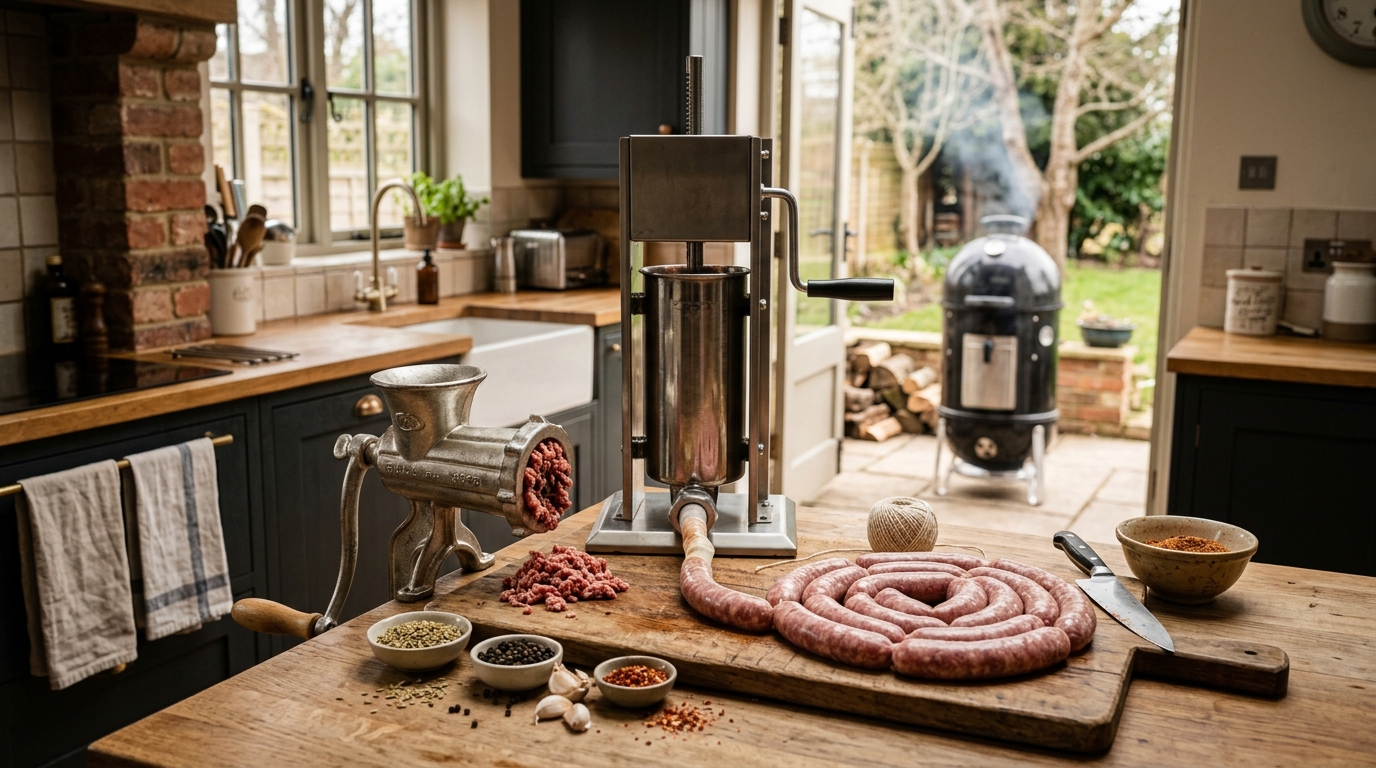
To make smoked sausage at home, grind your meat at a 70/30 lean-to-fat ratio, mix in curing salt and seasonings, stuff natural hog casings, and cold-smoke at 130–150°F for two hours before raising heat until the links hit 155°F internal temperature. The full process takes about six hours and produces far better sausage than anything from the grocery shelf.
What equipment do you need to make smoked sausage?
You do not need a professional setup to produce excellent homemade smoked sausage, but a few items are non-negotiable. Skipping the dedicated stuffer or relying on scale estimation for curing salt leads to either food safety risks or unusable texture.
Non-negotiable equipment:
- Meat grinder — an electric grinder with a 3/16-inch plate is the standard for sausage. Stand mixer attachments work but are slower and generate more heat. A dedicated electric grinder handles the volume better and keeps the meat colder.
- Sausage stuffer — a 5-pound vertical stuffer gives you much better control than a grinder stuffing tube. Grinder tubes are awkward to operate solo and trap air pockets.
- Accurate kitchen scale — curing salt is measured in grams. A scale accurate to 1 gram is essential for food safety. Do not estimate this by eye.
- Instant-read or probe thermometer — to verify the sausage reaches a safe internal temperature before pulling from the smoker.
- Natural hog casings — 32–35 mm diameter is standard for bratwurst- and kielbasa-style links. Rinse thoroughly and soak in cold water for 30 minutes before use.
Helpful but not strictly required:
- A sharp boning or butcher knife for breaking down primal cuts
- Butcher twine for tying link ends
- A dedicated smoker (any type — offset, pellet, electric — works for sausage)
Starter equipment to look at: 5-pound vertical sausage stuffer on Amazon | electric meat grinder with stuffing tubes on Amazon
What is the best meat ratio for smoked sausage?
The fat percentage determines texture, moisture, and flavor more than any seasoning decision. Too lean and the sausage dries out and crumbles. Too fatty and the links become greasy and can rupture during smoking.
The standard ratio: 70% lean, 30% fat.
For most smoked sausages — bratwurst, kielbasa, andouille, smoked Italian — a 70/30 blend is the baseline. Pork shoulder (Boston butt) naturally runs 75–80% lean depending on the cut, so you get close to the right ratio without adding extra fat. For pork-and-beef blends, use lean beef chuck plus pork back fat trimmed to a 70/30 total.
Common base meats and their characteristics:
| Product | Best for | Rating | Notes | |
|---|---|---|---|---|
| Pork shoulder (Boston butt) | Almost every sausage style | ★★★★★ | Natural fat marbling means little extra fat is needed. Forgiving, flavorful, widely available. The best starting point for most home sausage makers. | — |
| Beef chuck (80/20) | Kielbasa, smoked Polish sausage | ★★★★☆ | Pairs well with pork. Use 70% chuck plus 30% pork back fat for the ideal blend. Produces a deeper, beefier flavor profile. | — |
| Venison | Game sausage blends | ★★★★☆ | Naturally very lean — requires adding 20–25% pork back fat to reach the right ratio. Without added fat, venison sausage turns dry and chalky. | — |
| Chicken thighs | Poultry sausage | ★★★★☆ | Skin-on thigh meat ground together provides enough fat. Pull to 165°F internal temperature (higher than pork). Mild flavor takes seasoning well. | — |
How to make smoked sausage: step-by-step
Step 1: Grind the meat cold
Cut the meat and fat into 1-inch cubes. Freeze the cubed pieces on a sheet pan for 20 to 30 minutes — stiff but not frozen solid. Freeze the grinder auger, blade, and plates for the same period. Cold meat and cold equipment prevent fat smearing, which turns the texture greasy and dense instead of firm and sliceable.
Run the meat through the coarse plate (3/8-inch or 1/2-inch) first. Spread the ground meat on the sheet pan and return it to the refrigerator while you clean the grinder, then run it through the fine plate (3/16-inch or 1/4-inch) for the final grind. One pass through the fine plate is enough for bratwurst- and kielbasa-style texture. Two passes produce a finer, more emulsified result closer to hot dogs.
If the mixture starts to feel warm or looks greasy at any point, stop and refrigerate for 15 minutes before continuing.
Step 2: Mix in the cure and seasonings
Weigh your ground meat mixture accurately. For hot-smoked sausage, Prague Powder No. 1 (also called InstaCure No. 1 or pink curing salt No. 1) is required. The standard rate is 1 teaspoon (approximately 6 grams) per 5 pounds of meat. Prague Powder contains sodium nitrite, which is effective at this concentration and harmful at higher doses. Do not exceed the specified amount.
Prague Powder No. 1 curing salt on Amazon
Mix your dry seasonings and the cure with 1/4 cup of ice water per 5 pounds of meat, stir briefly to dissolve, and pour the slurry over the ground meat. The liquid distributes the cure evenly and helps develop the protein bind.
Basic smoked sausage seasoning per 5 pounds of meat:
- 2 tablespoons kosher salt
- 1 tablespoon coarse black pepper
- 1 tablespoon garlic powder
- 1 teaspoon smoked paprika
- 1 teaspoon mustard seed (optional but traditional in kielbasa)
- 1 teaspoon Prague Powder No. 1
Mix by hand — or in a stand mixer with the paddle attachment on low speed — until the mixture becomes distinctly sticky and tacky. Pinch a small chunk and squeeze it: it should hold a firm impression and not crumble when released. This sticky consistency means myosin proteins are unfolding and binding together, which produces a snappy, cohesive finished link rather than loose, crumbly sausage. Most cooks mix for 4 to 5 minutes by hand. Undermixing is the single most common mistake beginners make.
Step 3: Stuff the casings
Rinse natural hog casings under cold water and soak them in a bowl of cold water for 30 minutes to soften and remove excess salt. Slide the entire length of casing onto the stuffer tube before you begin — thread it all the way on, leaving a few inches hanging off the end. Tie a knot at the open end.
Pack the stuffer cylinder with the seasoned meat mixture, pressing firmly to remove air pockets, and thread the piston in. Feed the meat slowly and steadily into the casing, using your non-dominant hand to apply gentle back-pressure on the casing as it fills. Overfilling causes the casings to burst during smoking; underfilling gives the sausage a wrinkled, deflated appearance. Aim for firm but not drum-tight — the casing should yield slightly when pinched.
Twist links at your desired length — 5 to 6 inches is standard. Alternate the direction of each twist to prevent them from unraveling: twist clockwise for the first link, counterclockwise for the second, and so on. Hang the stuffed links on a rod or lay them on a wire rack in a single layer with space between them.
Step 4: Develop the pellicle
A pellicle is the tacky, slightly dried surface on the casing that allows smoke particles to bond evenly during the cook. Without it, smoke beads up on moist casings and produces blotchy, uneven color and under-penetrated flavor.
Place the stuffed links on a wire rack and refrigerate uncovered for 1 to 2 hours. Alternatively, hang them in a cool area (below 60°F) with airflow. The surface should feel dry and sticky to the touch before the links go into the smoker. This step is skipped far too often and is the most frequent cause of disappointing smoke character on homemade sausage.
Step 5: Smoke the sausage low and slow
Set your smoker to 130°F. Place the links on the grate with at least an inch of space between each one so smoke and air can circulate freely. Run the smoker at 130°F for 30 to 60 minutes with no wood — this completes the pellicle formation and starts drying the exterior before smoke is introduced.
Raise the temperature to 150°F and add your chosen wood. For most smoked sausages, apple, hickory, or cherry work well (see the wood guide below). Run smoke for the next 1.5 to 2 hours. Look for thin, nearly-invisible blue smoke from the chimney. Thick white smoke means incomplete combustion and produces a harsh, bitter flavor that cannot be corrected once it has penetrated the casing.
After the smoke phase, raise the smoker temperature to 170–180°F and continue cooking without additional wood until the links reach 155°F internal temperature. Use an instant-read or probe thermometer inserted into the thickest part of the link, avoiding the center fat core if there is one. At 170–180°F ambient, reaching 155°F internal typically takes an additional 1 to 1.5 hours depending on the diameter of the links.
Approximate timeline for 32–35mm links:
- 0:00 — 130°F, no smoke, 30–60 minutes
- 1:00 — 150°F, add wood smoke, 1.5–2 hours
- 2:30–3:00 — 170–180°F, no additional wood, finish to 155°F internal (about 1–1.5 hours more)
Step 6: Ice bath, bloom, and store
When the links reach 155°F internal, pull them from the smoker and plunge immediately into an ice bath — a large bowl or clean sink filled with ice and water — for 10 to 15 minutes. This rapid chill stops carryover cooking, prevents the casings from wrinkling, and locks in the juices.
After the ice bath, pat the links dry and hang them or lay them on a rack at room temperature for 20 to 30 minutes. This is the bloom: the color deepens from pale pink to a rich mahogany as myoglobin reacts to oxygen exposure. Do not skip the bloom — it is purely aesthetic but the difference in appearance is substantial.
Refrigerate finished sausage in an airtight container or vacuum bag for up to 7 days. Vacuum-sealed and frozen, properly cured smoked sausage keeps for 3 months with no quality loss.
How to choose wood for smoked sausage
Smoke flavor is more concentrated in sausage than in large cuts because the casing traps it close to the meat. Use wood more conservatively than you would for brisket or pork shoulder.
- Hickory — classic American choice for kielbasa, andouille, and smoked pork sausage. Bold, slightly sweet, deeply recognizable.
- Apple — mild, subtly sweet, and the most forgiving choice for beginners. Excellent for bratwurst and white sausage styles.
- Cherry — adds a rich mahogany color to the casing in addition to mild sweetness. Outstanding for any pork-based blend.
- Maple — clean, sweet smoke with a slightly lighter character than hickory. Works particularly well with chicken sausage.
- Pecan — sweeter and more complex than hickory with a nutty undertone. A strong all-around option for pork and beef blends.
Avoid mesquite for smoked sausage. The smoke is too intense for the 2-plus hours of exposure at close range, and the result turns acrid and bitter.
A wood chunk variety pack for testing flavors: smoking wood chunks variety pack on Amazon
Common mistakes when making smoked sausage at home
Skipping the cure. For any sausage spending time below 200°F in a smoker, Prague Powder No. 1 is a food safety requirement. Without it, the extended time in the 40–140°F danger zone creates ideal conditions for Clostridium botulinum growth. If you want to skip the cure, skip the low-and-slow smoking phase entirely and cook sausage directly at 325°F or higher on the grill.
Undermixing the protein bind. If the seasoned meat paste looks like crumbled ground beef rather than a smooth, cohesive mass, keep mixing. The finished sausage will be loose and crumbly instead of snappy. Mix until the paste is distinctly tacky and holds a clear impression when pressed.
Smoking too hot, too soon. Starting above 160°F causes the fat to render before the protein matrix sets, resulting in fat pouring out of the casing and a collapsed, greasy link — a defect called fat-out. Always begin at 130°F and raise temperature in stages.
Burst casings. Natural casings split from overfilling or a sudden temperature spike. Keep stuffing tension firm but not stretched, and bring the smoker temperature up gradually rather than jumping straight to high heat.
Skipping the ice bath. Leaving links at room temperature after pulling from a 180°F smoker pushes them through overcooking territory during carryover. The ice bath stops the cook immediately, keeps casings tight, and produces a cleaner texture.
FAQ
Frequently asked questions
Do I need curing salt to make smoked sausage?
What internal temperature does smoked sausage need to reach?
Can I make smoked sausage without a meat grinder?
How long does homemade smoked sausage last?
Why did my sausage turn out dry and crumbly?
What is the difference between hot smoking and cold smoking sausage?
Bottom line
Making smoked sausage at home comes down to three things: the right fat ratio (70/30), a precise dose of curing salt, and a gradual temperature ramp that lets the smoke set before the fat renders. Get those three right and the results will outperform anything commercially available. Start with pork shoulder — it is forgiving, naturally fatty, and produces excellent sausage across every style from bratwurst to andouille. Once the basic process is familiar, adjusting seasonings and wood type is where all the real creativity begins.
For related reading: how to use a smoker — setup and fire management basics, how to smoke pork ribs — timing, wood, and the 3-2-1 method, best smokers for every budget and style, or best BBQ gloves for handling hot grates and links safely.